Breathe slower.
Pick box breathing, 4-7-8, coherent breathing or a short energiser, choose 1 to 10 minutes and follow a circle that grows as you inhale and shrinks as you exhale. At the end you see your cycles, your breathing rate and the minutes you have collected so far.
Pick a pattern, press start and follow the circle.
The circle grows while you inhale, rests while you hold and shrinks while you exhale. Sit down, drop your shoulders and breathe through the nose.
Pattern
Four equal sides: inhale 4 s, hold 4 s, exhale 4 s, hold 4 s.
Length
11 cycles of 16 s, 2:56 in total.
Space starts and pauses. Every session ends on a complete cycle, and nothing leaves your browser.
Box breathing, 2 minutes 56 seconds.
You have breathed 3 minutes with VitaVias so far.
How it works.
- Choose one of four patterns and a length of 1, 3, 5 or 10 minutes.
- Press start and follow the circle: it grows while you inhale, rests while you hold and shrinks while you exhale.
- Read the summary: cycles, time breathed, breaths per minute and the minutes you have collected so far.
What slow breathing does
An adult at rest takes about 12 to 20 breaths per minute. The four patterns in this studio bring that down to between 3 and 6 breaths per minute. A long exhale raises the activity of the vagus nerve, the main line of the parasympathetic nervous system, and heart rate variability increases: the interval between beats starts to swing in time with the breath. That swing is strongest at around 6 breaths per minute, roughly 0.1 Hz, the resonance frequency used as the target in HRV biofeedback. Coherent breathing sits exactly there. Box breathing and 4-7-8 are slower and add holds, which is why they feel heavier and are best practised sitting down. Five minutes is enough for a measurable drop in pulse; a calmer baseline needs weeks of regular practice. It is also the natural companion to a facial massage.
Where the numbers come from
Box breathing, four equal sides of 4 seconds, is taught to military and emergency personnel to steady the pulse before a demanding task; its 16-second cycle works out at 3.75 breaths per minute. The 4-7-8 rhythm was popularised by the American physician Andrew Weil and borrows from yogic pranayama: 4 seconds in through the nose, 7 seconds held, 8 seconds out through the mouth, a 19-second cycle at roughly 3.2 breaths per minute. Coherent breathing, 5.5 seconds in and 5.5 seconds out, follows the biofeedback protocol described by Lehrer and Gevirtz in 2014, in which most adults reached their largest heart rate swing between 4.5 and 6.5 breaths per minute. The energiser, 4 in, 2 held, 4 out, is a gentle take on faster activating patterns: 6 breaths per minute without the light-headedness that 2-second inhales can cause. Every session here ends on a complete cycle, so 3 minutes of box breathing runs to 2 minutes 56 seconds and 3 minutes of 4-7-8 to 2 minutes 51 seconds. Where a few slow minutes fit into an afternoon of rest is a matter of habit more than timing.
What this tool is not
The Breathing Studio is a pacing aid. It is not a treatment for anxiety disorders, panic attacks, asthma or any other condition, and it does not replace a doctor or a therapist. Long holds can make you dizzy, especially when you stand, are pregnant or have low blood pressure: stop, breathe normally and choose coherent breathing next time. Never use it while driving, cycling or in water. If slow breathing regularly leaves you feeling worse, mention it to a professional. The minutes counter is a habit tracker, not a medical record. After a session, a gentle head massage is a good next step.
Frequently asked.
Which pattern should I start with?
Coherent breathing, 5.5 seconds in and 5.5 seconds out, has no holds and suits almost everyone. Move to box breathing or 4-7-8 once the slower rhythm feels comfortable, and keep the energiser for the afternoon rather than bedtime.
Why does the circle stop at the top and at the bottom?
Those pauses are the holds. Box breathing holds for 4 seconds after both the inhale and the exhale, 4-7-8 holds for 7 seconds after the inhale, and coherent breathing has no holds at all, so its circle never stops moving.
Should I breathe through the nose or the mouth?
Inhale through the nose in every pattern. The 4-7-8 tradition exhales through slightly pursed lips with a soft sound; the other patterns work with a quiet nasal exhale. Whatever you choose, keep the shoulders down and let the belly move first.
What if I feel light-headed?
Stop, sit down and breathe normally for a minute. Light-headedness usually comes from holding too long or exhaling too forcefully; next time pick a pattern without holds and a shorter session. Do not use the studio while driving or in water.
Where is my minutes total stored?
In your browser, under a single local storage entry. Nothing is sent to a server, so the total belongs to this device and this browser, and it disappears when you clear the site data.
How much slow breathing is worthwhile?
Most studies use 5 to 20 minutes a day for several weeks. Even 3 minutes before a meeting or after a screen-heavy afternoon produces a change you can feel in the pulse, so a short session done daily beats a long one done rarely.
Guides behind this tool
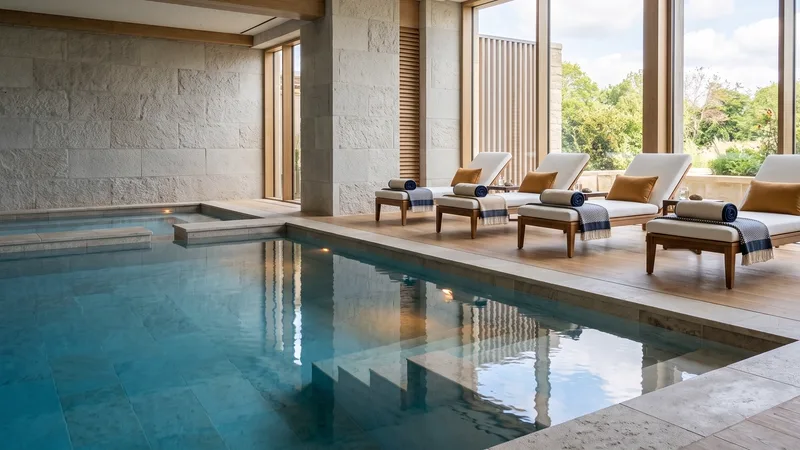 Wellness
Spa day: the order makes the difference
Wellness
Spa day: the order makes the difference
 Massage
Facial massage: direction is everything
Massage
Facial massage: direction is everything
 Massage
Head massage: the scalp is mobile
Massage
Head massage: the scalp is mobileMore tools
The Breathing Studio paces your breath; it does not treat anxiety disorders, panic attacks or any breathing condition. Stop if you feel dizzy, and never use it while driving. This page is for general information and does not replace medical or professional cosmetic advice.