Paraffin bath: warmth that stays on the skin
A paraffin wax bath means dipping hands or feet 4 to 8 times into liquid wax kept at about 50 degrees Celsius, then wrapping them in plastic film and a towelling mitt for 15 to 20 minutes while the cooling wax forms an airtight seal that locks moisture against the skin. The softer feel it leaves behind can last for several days, and a single portion of wax is used once, then thrown away.
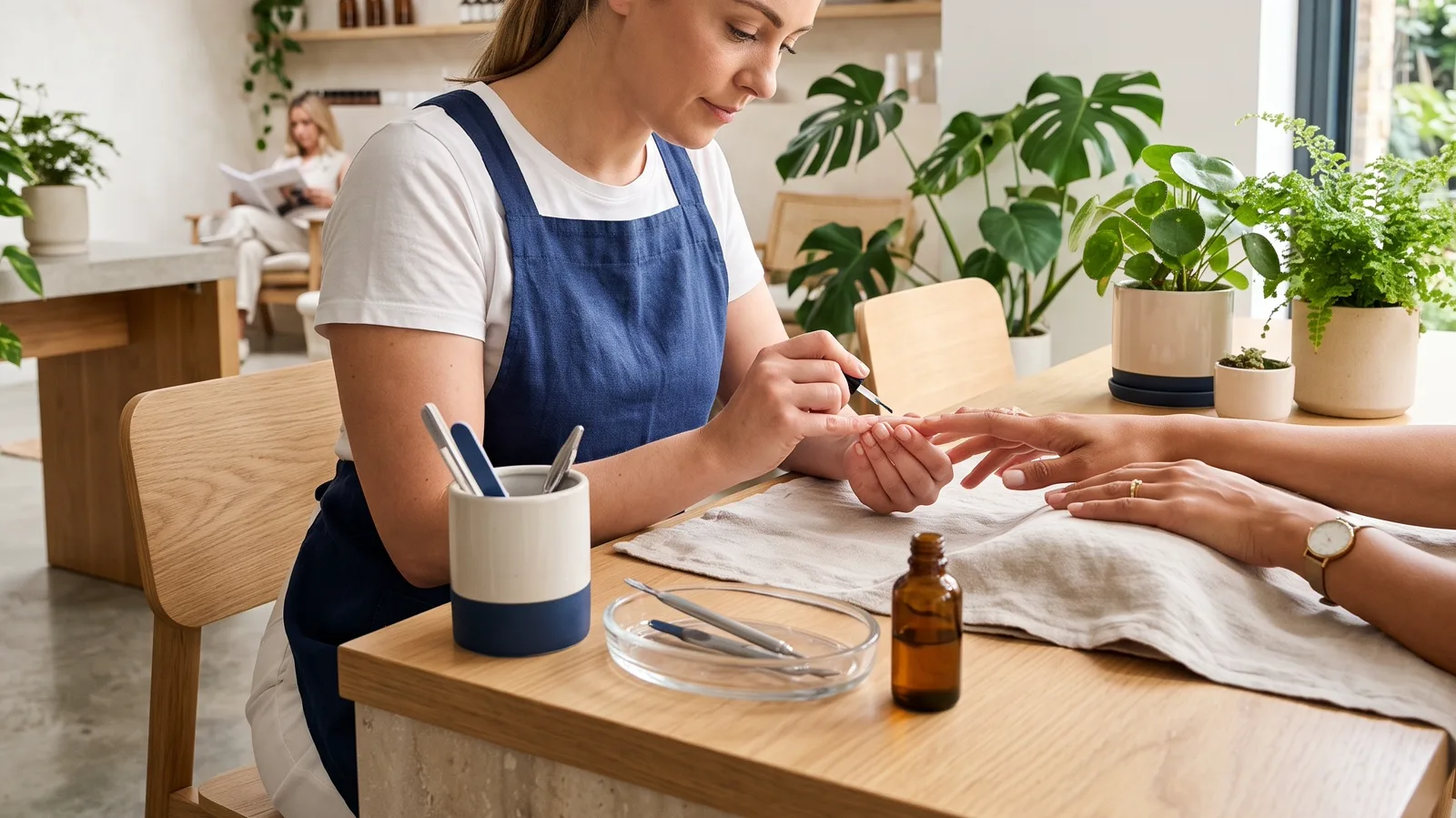
How a paraffin session runs
A paraffin unit holds its wax at roughly 50 degrees Celsius, a temperature that would feel uncomfortably hot under a tap held for long, yet stays safe here because solid wax conducts heat far more slowly than water. Cosmetic-grade paraffin generally melts in a narrow band around 50 degrees Celsius too, which is one reason the bath itself runs at close to that figure rather than any hotter. A thin layer of hand or foot cream goes on first, then the hand or foot goes through 4 to 8 quick dips, lifted out for 2 to 3 seconds between each one so the previous layer sets before the next covers it.
Once the last layer has set, the hand or foot is wrapped in plastic film and a towelling mitt to hold the heat in for 15 to 20 minutes. The solid shell, by then several millimetres thick, is peeled off in one piece and thrown away, since each portion of wax is single use rather than returned to the pot for the next client. The whole appointment, dips and wrap included, runs about 25 to 30 minutes from start to finish, roughly the length of a short lunch break.
A home version works the same way on a smaller scale: a countertop unit holds around 2 to 3 kilograms of wax at the same 50 degrees Celsius, enough for 1 pair of hands or feet per fill, and most manufacturers recommend replacing the whole batch after about 15 to 20 uses once it starts picking up dust and skin cells.
| Detail | Typical value |
|---|---|
| Wax temperature | about 50 degrees Celsius |
| Quick dips per session | 4 to 8 |
| Time wrapped afterwards | 15 to 20 minutes |
| Full appointment length | 25 to 30 minutes |
| Added cost as a manicure or pedicure add-on | 15 to 30 US dollars |
| Burn study wax layers and heat | 10 to 14 layers at 42 to 44 degrees Celsius |
| Burn study schedule | 3 sessions a week for 8 weeks |
| Stiff hand study schedule | 4 sessions a week for 6 weeks |
| Study sample sizes | 40 and 36 patients |
What the wax and the warmth do
Two effects follow. The airtight wax layer stops the cream underneath from evaporating, so it absorbs far more thoroughly than it would in open air, which is why hands feel noticeably softer afterwards, an effect that typically holds for several days rather than fading within hours. Separately, the warmth itself relaxes muscles and joints and increases local blood flow for as long as the wrap stays on, an effect most people notice within the first 5 minutes.
That combination is why paraffin dips turn up for very dry hands, rough winter skin and stiff finger joints as much as for softness alone. Added to a manicure or pedicure, it typically adds about 25 minutes and 15 to 30 US dollars to the appointment, and salons that offer it as a stand-alone service often recommend repeating it once every 1 to 2 weeks through the driest months rather than year round.
What the studies behind it show
Outside the beauty chair, paraffin wax has a physiotherapy record too. In a trial of 40 patients with stiff finger joints from healed burns, therapists brushed on 10 to 14 layers of wax at 42 to 44 degrees Celsius, covered the hand for 20 minutes, and repeated that 3 times a week for 8 weeks; average finger joint movement improved by more than 9 degrees over the course of the study, alongside stretching done 3 sets a day.
A separate trial in 36 patients with hands stiffened after injury applied wax 4 days a week for 6 weeks, always right before hand exercises rather than on its own, and recorded measurable gains in wrist bending, wrist extension and thumb movement within that same 6 week window. In both studies the wax was one part of a supervised programme repeated many times, not a single stand-alone treatment, and neither trial reported a burn or a skin reaction serious enough to stop a participant continuing.
When to skip it
Wax is not dipped over open wounds, fresh cuts, grazes, ulcers or an active patch of eczema in the area to be treated, and the same applies to a joint that already feels hot to the touch, for example during a flare of rheumatoid arthritis. An allergy to paraffin wax rules it out too, and most clinics ask clients to have been free of any infectious illness for at least 48 hours beforehand.
Poor circulation, diabetes with reduced feeling in the hands or feet, and acute inflammation with swelling are further reasons to stay out of the wax, because reduced sensation raises the risk of an unnoticed burn even at a temperature that feels fine to most people within the first few seconds. A careful salon or clinic asks about all of this before the first of the 4 to 8 dips, not after the wrap is already on.
Spa add-on or clinical routine
The same treatment covers 2 quite different uses. As a spa add-on, one session every 1 to 2 weeks through autumn and winter is usually enough to keep very dry hands comfortable, and most people notice the softer feel within minutes of the wrap coming off. As a clinical routine for stiff or post-injury joints, the evidence above points to a pattern closer to 3 to 4 sessions a week for 6 to 8 weeks, always paired with exercise rather than replacing it.
Either way, the wax itself does not change between settings, only how often it is repeated and what it is combined with. A first-time visitor to a podiatry practice for stiff toe joints should expect a schedule closer to the clinical end, while someone booking it alongside a routine manicure for dry skin is firmly in the once-a-fortnight camp.
Questions to ask before you book
- Is the wax kept at a steady, controlled temperature, and is it checked before your hand or foot goes in?
- Is a fresh layer of cream applied before the dips, and is the set wax thrown away rather than reused?
- Will you be asked about diabetes, circulation problems, open wounds or allergies first?
- Is it offered as part of a manicure or pedicure, and how much extra time and cost does it add?
Frequently asked
How hot is a paraffin bath?
About 50 degrees Celsius. That would feel too hot under running water, but solid wax conducts heat slowly, so 2 to 3 seconds of contact per dip and a wrapped 15 to 20 minute rest stay comfortable.
Why does hand cream work better afterwards?
The airtight wax layer stops the cream underneath from evaporating, so it absorbs more thoroughly than in open air. The softer feel this leaves behind usually lasts for several days.
Is the wax reused between clients?
No. The set layer is peeled off and thrown away after every use, so only the unused stock in the heater is shared, never a client's own worn wax.
Who should avoid a paraffin bath?
Anyone with open wounds, active eczema, a hot or swollen joint, poor circulation or diabetes with reduced feeling in the hands or feet, since reduced sensation raises the risk of an unnoticed burn.
Does it actually help stiff joints, or is it just pampering?
Trials in post-burn and post-injury hands used it 3 to 4 times a week for 6 to 8 weeks alongside exercise and recorded measurable gains in joint movement, so the warmth effect is real, though it works best paired with exercise rather than alone.
How often can it be repeated for dry skin alone?
Once every 1 to 2 weeks through the colder months is a common salon routine, well short of the 3 to 4 times a week used in the clinical studies above.
Sources
- Paraffin wax hand therapy · NHS trust patient leaflet on dipping technique, wear time and who should not have the treatment
- Paraffin wax bath therapy versus therapeutic ultrasound in post-burn contractures · NIH-hosted trial giving wax temperature, layer count, session length and joint movement gains
- Paraffin wax bath in rehabilitation of the post-traumatic stiff hand · NIH-hosted trial on session frequency and duration alongside hand exercise
Read on
 Hands, Nails, Feet
Manicure: the cuticle is the crux
Hands, Nails, Feet
Manicure: the cuticle is the crux
 Hands, Nails, Feet
Pedicure: where cosmetics ends
Hands, Nails, Feet
Pedicure: where cosmetics ends
 Hands, Nails, Feet
Podiatry: a health profession, not cosmetics
Hands, Nails, Feet
Podiatry: a health profession, not cosmeticsTools that fit
This guide is for general information. It does not replace medical or professional cosmetic advice or an examination.