Manicure: the cuticle is the crux
The one step that decides whether a manicure is good or just looks good is the cuticle: it should be softened and pushed back with a wooden stick or metal pusher, never cut, because it seals the narrow gap between the nail plate and the skin against bacteria and fungi. A classic manicure without polish takes 30 to 45 minutes, or 45 to 60 with polish, and cutting that seal is the single most common route to paronychia, the painful infection of the nail fold.
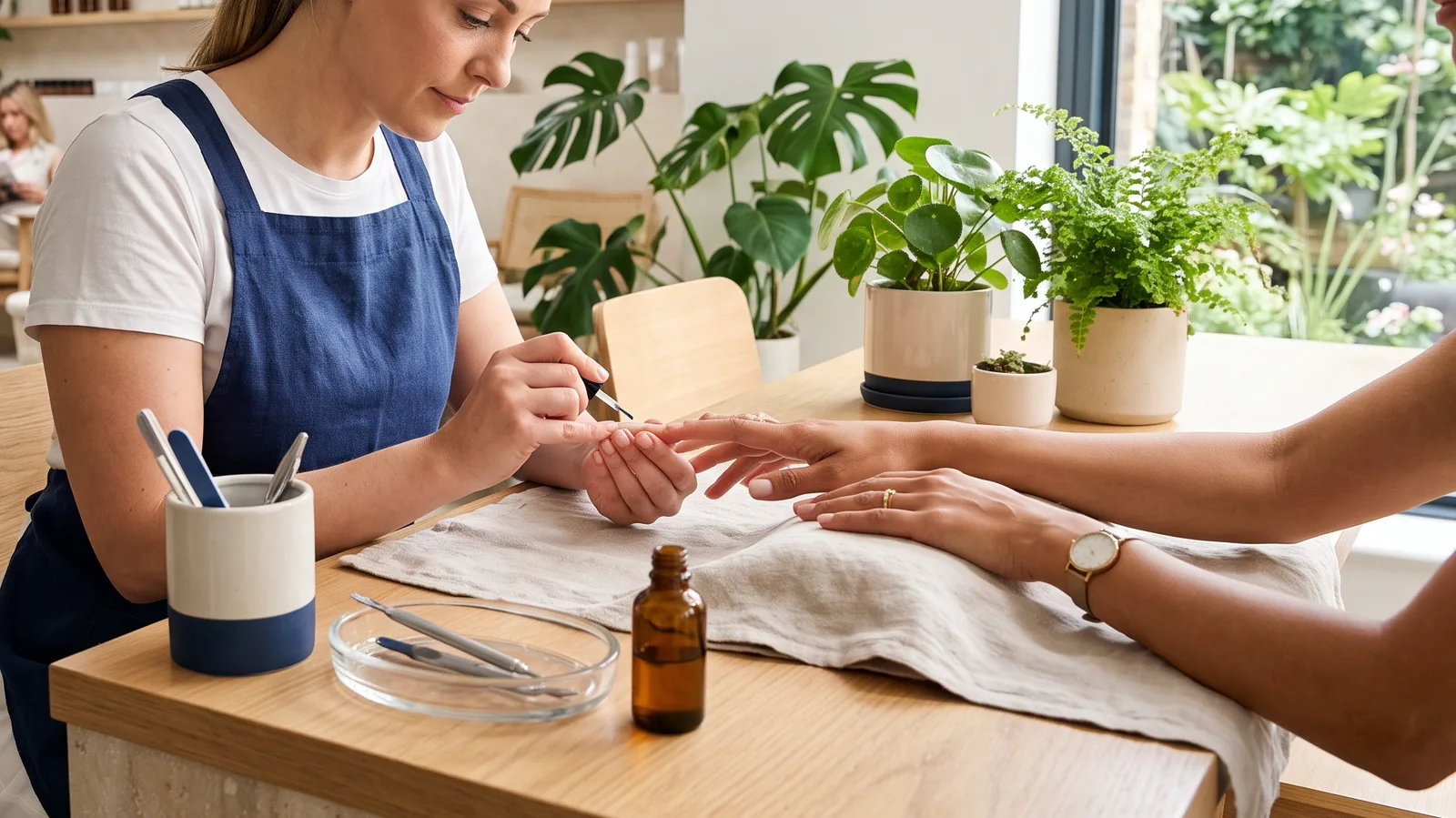
What happens, in order
Old polish comes off first, then the nail is filed to shape in one direction only, never back and forth. Hands go into a soak or a softening product for about 5 minutes, after which the cuticle is pushed back with a wooden stick or a metal pusher, a step that takes around 10 minutes for both hands. Only skin that is already dead and lifting away gets trimmed at this point, and only that.
What follows is nail bed care and a short hand massage, a few minutes that most clients rate as the best part of the appointment, then polish if wanted. Total time for a classic manicure without colour is 30 to 45 minutes; add polish and it runs 45 to 60. The final shape depends on the nail bed underneath it: round and oval spread pressure evenly around the free edge and hold up better day to day, while square corners take the full force of a knock in one spot and chip first. Shaping alone, done properly, takes 5 to 10 minutes per hand.
| Step | Purpose | Duration |
|---|---|---|
| Filing | Shape the nail, one direction only | 5 to 10 minutes |
| Soak or softener | Loosen the cuticle | 5 minutes |
| Pushing back the cuticle | Keep the seal intact | 10 minutes |
| Nail bed care and massage | Circulation, smooth skin | 5 to 10 minutes |
| Polish | Optional finish | 10 to 15 minutes |
Why the cuticle is not cut
The cuticle, known clinically as the eponychium, seals the transition between the nail plate and the skin behind it. Cut it and that seal opens, giving bacteria such as Staphylococcus aureus and Streptococcus, or the yeast Candida, a direct route under the skin. The result is paronychia, a red, swollen and often painful inflammation around the nail fold, and the cuticle typically grows back thicker after repeated cutting, inviting the same cut again next time.
Clinicians draw the line between acute and chronic paronychia at 6 weeks of symptoms: an acute case usually clears completely within a few days with warm soaks 2 to 3 times a day, while a chronic one can persist for months and is more common in people whose hands are frequently in water or who have diabetes. A manicure that draws blood has not gone slightly wrong, it has caused an injury, and only skin that is already dead and separating should ever come off.
Nail shape and how fast it grows
Fingernails grow at roughly 3 millimetres a month, about 0.1 millimetres a day, so a nail plate cut back to the quick takes 4 to 6 months to fully renew itself. Toenails grow closer to 1 millimetre a month and can take 12 to 18 months to replace themselves fully, one reason a pedicure is timed and handled differently from a manicure on the hands.
Filing works best on dry nails, before any soak, because water softens the keratin layers and makes them shear unevenly under the file rather than cut cleanly. One direction only matters here too: sawing back and forth splits those layers apart, and a nail that has been sawn rather than filed peels and snags at the tip within days rather than weeks. Clients who want length beyond what their own nail plate grows in a reasonable time usually look at nail enhancements instead of forcing natural growth.
Many manicurists offer a third option between round and square, a soft square often called squoval, filed with a gentle curve across the first 2 to 3 millimetres at each corner while the rest of the free edge stays straight. It keeps most of the strength of a rounded shape without losing the neat line a square tip gives on a wide nail bed.
Hygiene standards worth checking
Anything that can touch skin during a manicure has to be either single use or reliably disinfected between clients, and a rough emery board fails that test because its surface cannot be cleaned properly. That is why many studios issue one file per client to keep or use disposable abrasive heads, while metal tools such as pushers and nippers go through a proper sterilisation cycle, typically an autoclave run at around 134 degrees Celsius for several minutes, between every use.
The same rule applies at home: your own tools, never lent to anyone else, cleaned after every use rather than only when they look dirty. It sounds like overkill for a 30 minute routine, but it is the single measure that prevents the most common complication in nail care, an infection at the nail fold that started with one shared, unwashed pusher.
Between appointments
The whole set of fingernails grows at a similar average of about 3 millimetres a month, so new growth starts to show at the cuticle line after roughly 3 to 4 weeks, which is also the interval most studios use for rebooking a manicure. Working hand cream into the cuticle once or twice a day keeps it soft enough that it only ever needs pushing back at the next appointment, not cutting.
Anyone tidying cuticles at home should keep the same 2 rules a studio follows: one direction with the file, and tools that belong to one person only. A metal pusher rinsed in hot water and dried after use, rather than wiped on a towel and put away damp, is the minimum standard between two uses by the same hands.
Questions to ask before you book
- Do metal tools come out of a sterilisation unit, or just a drawer?
- Is my nail file new or assigned to me alone, not shared with the last client?
- Will the cuticle be pushed back, or is it going to be cut?
- How long does the appointment take with and without polish?
Frequently asked
Why should the cuticle never be cut?
It seals the gap between the nail plate and the skin behind it. Cutting it opens a route for bacteria and fungi and is the most common cause of paronychia, the painful infection of the nail fold.
Which direction should a nail file move?
Always in one direction, never back and forth. Sawing splits the layers of the nail plate and leaves the free edge weak, so it peels within days.
Which nail shape lasts longest?
Round and oval shapes spread pressure evenly around the free edge. Square corners take the full force of a knock in one spot and chip first.
How do I know a studio's hygiene is adequate?
Metal tools should come out of a sterilisation unit run at around 134 degrees Celsius, not a drawer, and files should be single use or kept for you alone. Ask before you sit down.
How long does a manicure take?
A classic manicure without polish runs 30 to 45 minutes. With polish, plan for 45 to 60 minutes.
What if the skin around my nail turns red and sore after a manicure?
That is the start of paronychia. Soaking the finger in warm water 2 to 3 times a day helps a mild case within days, but pus, fever or spreading redness needs a doctor rather than another manicure.
Sources
- Paronychia · clinical overview of acute versus chronic nail fold infection and the 6 week cutoff
- Paronychia · NIH consumer health page; states directly that trimming the cuticle weakens the seal that keeps out germs
- Manicure and pedicure safety · American Academy of Dermatology: never cut or forcefully push back cuticles, plus what to check for at a salon (clean stations, hand washing, tool disinfection)
Read on
 Hands, Nails, Feet
Nail enhancements: infill instead of a new set
Hands, Nails, Feet
Nail enhancements: infill instead of a new set
 Hands, Nails, Feet
Paraffin bath: warmth that stays on the skin
Hands, Nails, Feet
Paraffin bath: warmth that stays on the skin
 Hands, Nails, Feet
Pedicure: where cosmetics ends
Hands, Nails, Feet
Pedicure: where cosmetics endsTools that fit
This guide is for general information. It does not replace medical or professional cosmetic advice or an examination.