Abhyanga: warm oil, long strokes
Abhyanga is the Ayurvedic full-body oil massage: 100 to 200 millilitres of oil warmed to roughly 38 to 40 degrees Celsius, moved over the body with long strokes along the limbs and circular strokes over the joints, often by 2 therapists working in sync. A session takes 60 to 90 minutes and is followed by 15 to 30 minutes of rest before a warm shower. It is a wellness treatment with early evidence for stress relief, not a medical therapy.
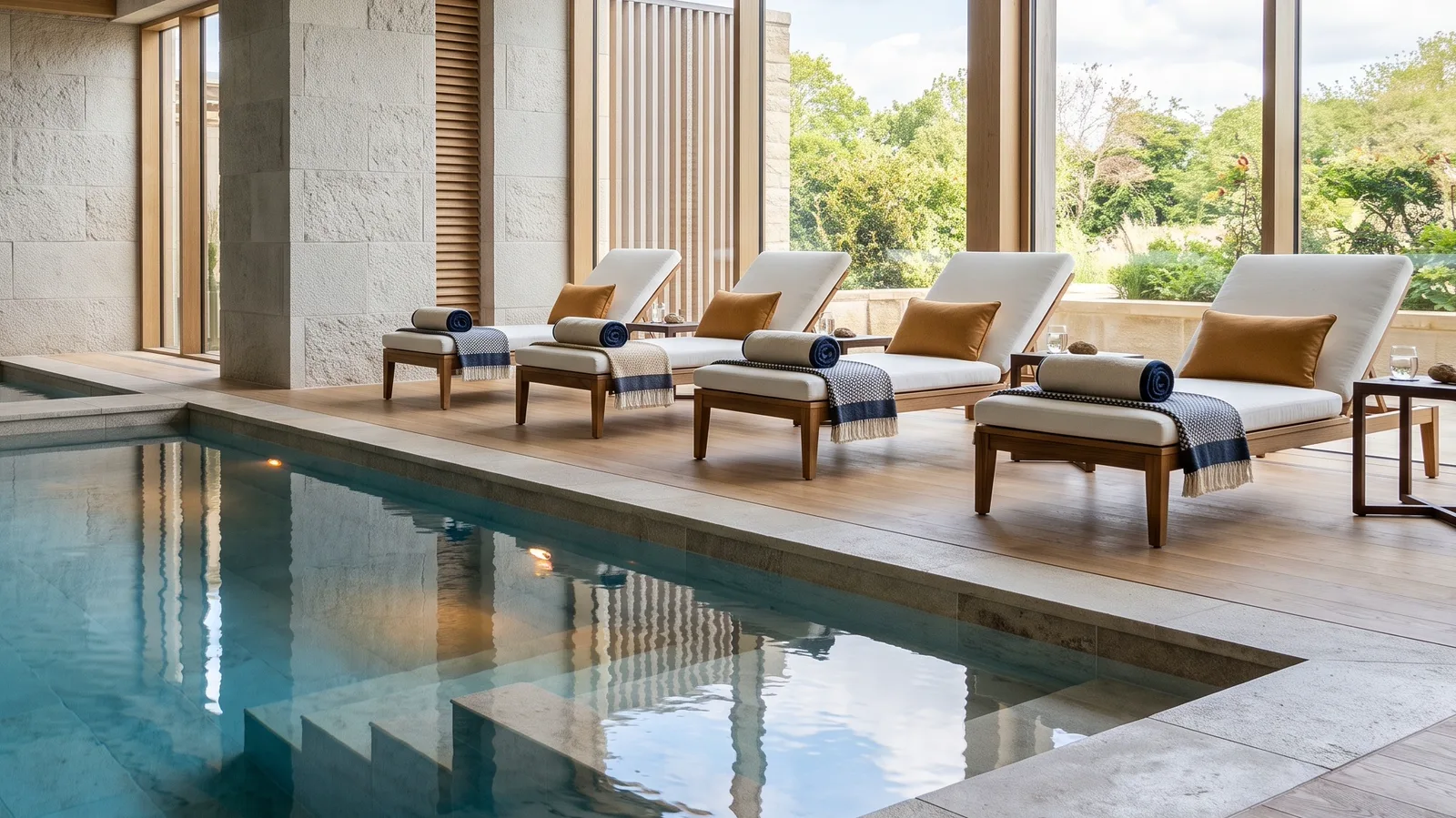
What sets Abhyanga apart
Most Western massage styles work the muscle: kneading, friction, pressure into a knot. Abhyanga does something else. The therapist spreads warm oil over the whole body and moves it with long, even strokes along the limbs and circular strokes over shoulders, elbows, hips and knees. Pressure stays light to medium, the hands rarely leave the skin, and rhythm matters more than depth. In the classical Kerala form the client passes through 7 positions, from sitting to lying on each side, so that every surface is covered in the same order each time. Many centres offer a four-hand version in which 2 therapists work the left and right side in sync.
The oil is the other difference. A classic full-body massage uses perhaps 10 to 20 millilitres; an Abhyanga uses 100 to 200 millilitres, warmed in a water bath to roughly 38 to 40 degrees Celsius, which is skin temperature and feels neutral rather than hot. Skin starts to object to prolonged contact from about 44 degrees, so a careful therapist tests each refill on the inside of the wrist. Sesame is the traditional base because it stays fluid, spreads well and is considered warming in Ayurveda; coconut oil is chosen for people who run hot or for summer, and sunflower is the usual neutral substitute. Herb-infused oils, simmered for hours with plant material, add a scent and 10 to 20 EUR to the price, but the technique is the same.
| Measure | Typical value | Note |
|---|---|---|
| Oil temperature | 38 to 40 °C | skin temperature, tested on the inner wrist |
| Oil quantity | 100 to 200 ml | a classic oil massage uses 10 to 20 ml |
| Massage time | 60 to 90 min | 45 min short form, 30 min head and shoulders |
| Rest afterwards | 15 to 30 min | shower only after, warm and mild |
| Room temperature | 24 to 26 °C | oiled skin cools quickly |
| Therapists | 1 or 2 | four-hand version works both sides in sync |
| Price | 70 to 150 EUR or 90 to 180 USD | four-hand roughly 1.5 to 2 times as much |
| Series | 1 per week for 4 to 6 weeks | daily for 7 to 14 days inside Panchakarma |
The session from door to shower
Plan 2 hours for a 60 to 90 minute treatment. The first 10 to 15 minutes are a conversation about your constitution in Ayurvedic terms (vata, pitta or kapha), medication, allergies and what you want from the session; this is where the oil is chosen. You undress fully or keep disposable briefs on, lie on a heated table, and the room is kept at 24 to 26 degrees because oiled skin cools fast. The massage usually runs head to feet: 5 to 10 minutes on the scalp, then face, neck, arms, front, back and legs, with the feet last. A short form of 45 minutes leaves out the head, and a head-and-shoulder version takes about 30 minutes.
The rest afterwards is part of the treatment, not an extra. You lie wrapped in towels for 15 to 30 minutes so the oil can sit on the skin and your temperature settles; some centres add 10 to 15 minutes of steam at 40 to 45 degrees in this window. Only then comes the shower: warm, not hot, with a mild cleanser or the traditional chickpea flour paste, and without a strongly degreasing soap, because a thin film of oil is meant to stay. Hair carries the oil for 1 to 2 washes. On days without a booking, 5 minutes of slow breathing in the Breathing Studio is the cheapest way to get part of the same effect.
The oil dictates the logistics. Wear old clothes, bring a hair tie and a towel for your hair, and do not book anything that needs a fresh shirt within the next 2 hours. Eat lightly and at least 2 hours before, because the abdomen is stroked in slow clockwise circles and a full stomach makes that unpleasant. In Western Europe a single 60 to 90 minute session costs around 70 to 150 EUR, in North America 90 to 180 USD; a four-hand session is roughly 1.5 to 2 times that. For a series, once a week for 4 to 6 weeks is the usual rhythm outside a full Panchakarma programme, where Abhyanga is given daily for 7 to 14 days.
What the evidence can and cannot say
Abhyanga has been studied far less than its popularity suggests. The best-known trial is a 2011 pilot study in a peer-reviewed complementary medicine journal: 20 healthy adults, 10 women with a mean age of 36.4 years and 10 men with a mean age of 37.0 years, received 1 hour of Abhyanga. Scores on a validated stress questionnaire and heart rate fell significantly afterwards, while blood pressure dropped only in the subgroup that started out prehypertensive. That is encouraging for relaxation, but it is 1 session, 20 people and no control group, and the larger trials the author called for have largely not followed.
For massage in general the picture is clearer. The US National Center for Complementary and Integrative Health rates the risk of harm as low, with rare reports of serious side effects such as a blood clot, nerve injury or bone fracture, mostly after vigorous techniques or in frail elderly patients. Use has grown: 10.9 percent of US adults had a massage in 2022, more than double the 4.8 percent of 2002, and about 240,000 adults there use Ayurveda itself. What no study supports are the detox claims attached to some offers. The oil does not draw anything out of the tissue; a good Abhyanga is worth booking for how it feels afterwards, not for what it supposedly removes.
Training, regulation and the questions to ask
Ayurveda is one of the oldest documented medical systems, and in 2022 the WHO published updated training benchmarks for it, 76 pages that set out what a practitioner and a therapist should have learned. A basic-level Ayurveda practitioner is expected to complete 3,000 hours (1,500 hours of theory, 1,000 hours of practical training and a 500 hour internship); an Ayurveda therapist, the person who typically performs Abhyanga, 1,000 hours. In India the degree behind a registered Ayurvedic doctor takes 5.5 years including a 1 year internship, and according to the WHO's 2019 global report 88 percent of its Member States acknowledge traditional and complementary medicine in health care.
Outside South Asia these benchmarks are recommendations, not law. In the United States no state licenses Ayurvedic practitioners, although massage therapists need a licence or certification in 45 states and the District of Columbia. In most of Europe Ayurvedic massage sits in the wellness sector rather than in medicine; the therapist's massage or physiotherapy qualification is what regulates the hands, and the Ayurvedic part is added in courses that range from a 3 day introduction to 2 years part-time. So ask: how many hours of Ayurveda training, which oil and whether it is infused, how it is warmed, whether the resting time is inside the booked 90 minutes, and whether 1 or 2 therapists work on you. Five answers separate a trained studio from a spa menu item.
Limits, allergies and who should wait
Abhyanga is gentle, which is why the list of reasons to postpone is short and mostly about heat, pressure and circulation. Wait with fever, an acute infection or inflammation, a fresh injury or operation, open or infected skin, and any suspicion of thrombosis, because stroking along a leg with a clot in it is exactly what must not happen. In pregnancy most centres decline the first 12 weeks, and later only a therapist trained in pregnancy massage should work the abdomen and lower back. Varicose veins, osteoporosis and blood-thinning medication call for lighter pressure and a conversation beforehand, and the same applies to essential oils added to the base.
The oil itself is the second consideration. Sesame is one of the 14 allergens that EU food law requires on labels and, since January 2023, the 9th major allergen under US law; a contact reaction on skin is uncommon but possible, and almond oil raises the same question. Say so at the consultation and the therapist swaps to coconut or sunflower. Ayurvedic herbal preparations to be swallowed are a different matter: a 2015 survey of users found raised blood lead in 40 percent of them, and about 1 in 4 of the supplements tested had high lead and almost half high mercury. Take nothing home to swallow without a doctor's view, and treat Abhyanga as what it is, a well-crafted hour of rest with a long tradition and early, small evidence behind it.
Before you book
- Ask which base oil is used and whether it is infused with herbs; mention sesame, nut or plant allergies.
- Ask how many hours of Ayurveda training the therapist has on top of a massage qualification.
- Confirm that the 15 to 30 minutes of rest are inside the booked time, not on top of it.
- Eat lightly, at least 2 hours before, and drink a glass of water afterwards.
- Wear old clothes, bring a hair tie and a hair towel, and leave the next 2 hours free.
- Mention fever, fresh injuries, thrombosis risk, blood thinners or pregnancy before the first stroke.
Frequently asked
How warm is the oil?
About 38 to 40 degrees Celsius, which is skin temperature and feels neutral on the body. It is kept in a water bath and topped up several times, because a full-body Abhyanga uses 100 to 200 millilitres.
Can I shower straight afterwards?
Not straight away. Rest for 15 to 30 minutes first so the oil can sit on the skin, then shower warm with a mild cleanser and without a strongly degreasing soap; hair needs 1 to 2 washes to lose the oil.
Is Ayurveda a recognised medical system?
In India it is, with a 5.5 year degree and a register of practitioners, and the WHO published training benchmarks of 3,000 hours for practitioners in 2022. In the United States no state licenses Ayurvedic practitioners, and in most of Europe Abhyanga counts as wellness, not medicine.
When should I not have Abhyanga?
With fever, acute inflammation, fresh injuries or surgery, infected skin, suspected thrombosis and in the first 12 weeks of pregnancy. With a sesame or nut allergy the treatment itself is fine, but the oil is switched to coconut or sunflower.
Can I do Abhyanga on myself?
Yes, daily self-massage is part of the traditional morning routine. Warm 30 to 50 millilitres of sesame oil, spend 10 to 15 minutes on long strokes along the limbs and circles on the joints, wait another 10 to 15 minutes and shower warm. Wash oily towels hot and never leave them bundled, because oil-soaked cotton can self-heat.
How often does it make sense?
Once is enough for an afternoon of rest. For a noticeable effect on sleep or tension most practitioners suggest 1 session a week for 4 to 6 weeks; inside a Panchakarma programme Abhyanga is given daily for 7 to 14 days.
Sources
- Ayurvedic Medicine: In Depth (NCCIH, National Institutes of Health) · about 240,000 US users, no state licensing of practitioners, 2015 survey with raised blood lead in 40 percent of users of ingested preparations
- Massage Therapy: What You Need To Know (NCCIH, National Institutes of Health) · low risk profile with rare serious side effects, licensing in 45 states, use by 10.9 percent of US adults in 2022 versus 4.8 percent in 2002
- Basler AJ. Pilot study investigating the effects of Ayurvedic Abhyanga massage on subjective stress experience. J Altern Complement Med 2011;17(5):435-440 · 20 healthy adults, 1 hour of Abhyanga, reductions in stress scores and heart rate; abstract via Europe PMC (PMID 21568717, doi 10.1089/acm.2010.0281), the journal page answers 403 to curl
- WHO benchmarks for the training of Ayurveda (World Health Organization, 2022) · 3,000 hours for basic-level practitioners, 1,000 hours for Ayurveda therapists, 88 percent of Member States acknowledge traditional and complementary medicine
Read on
 Massage
Lomi Lomi: long strokes with the forearm
Massage
Lomi Lomi: long strokes with the forearm
 Massage
Aromatherapy massage: dilution decides
Massage
Aromatherapy massage: dilution decides
 Massage
Full-body massage: five strokes, one sequence
Massage
Full-body massage: five strokes, one sequenceTools that fit
This guide is for general information. It does not replace medical or professional cosmetic advice or an examination.