Herbal peeling: exfoliation without acid
A herbal peel works by massaging a paste of dried plant powder into cleansed skin for 5 to 10 minutes, with no acid involved; the friction and the plant compounds loosen the bond between the outermost skin cells, and at the intense level visible peeling follows for 3 to 5 days, starting on day 2 or 3. Three intensities exist, from a mild refresh with no visible flaking to an intense course that needs real downtime, and a lasting result usually takes 2 to 4 sessions spaced 4 to 6 weeks apart.
How the massage replaces the acid
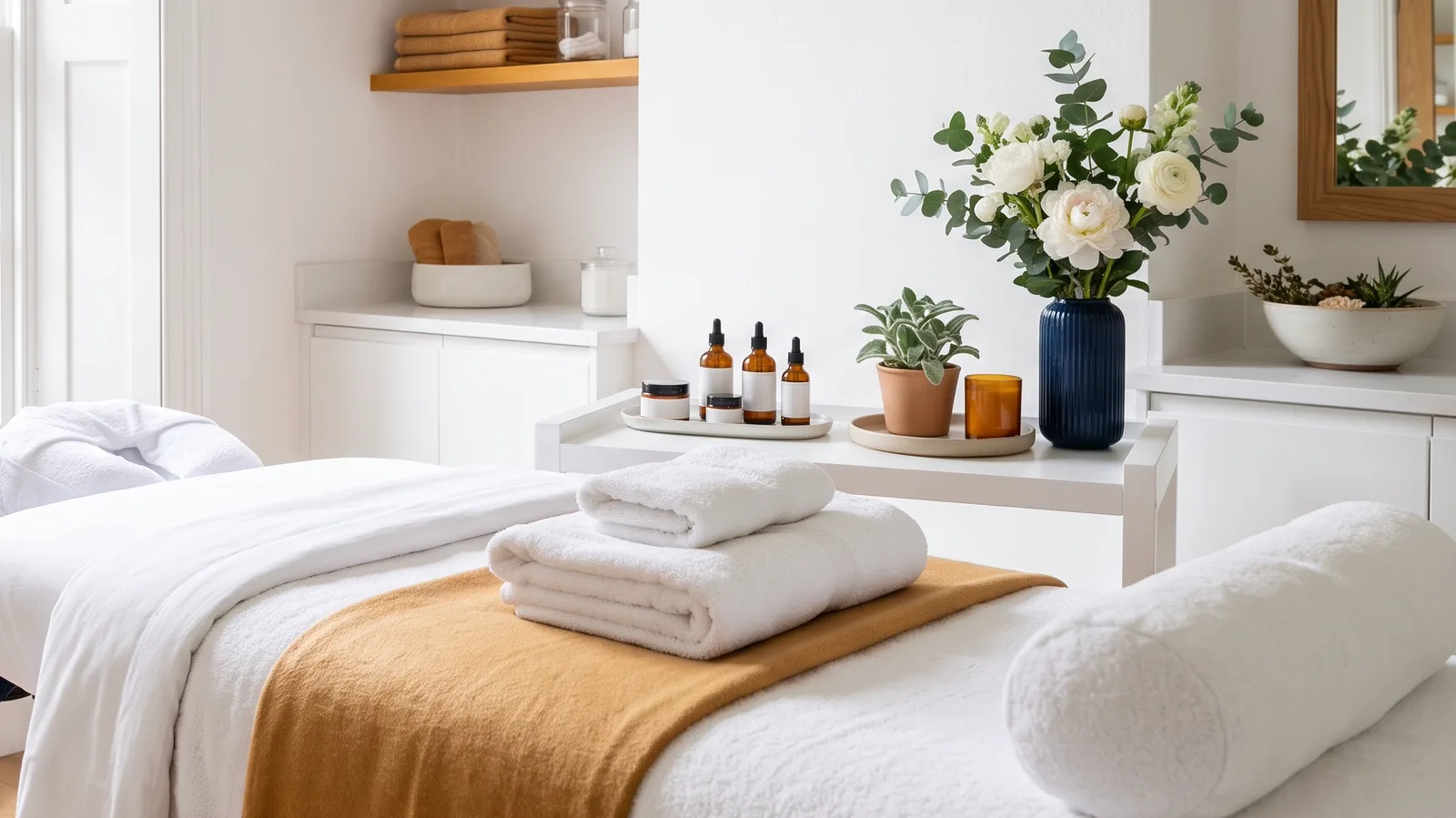
A herbal peel skips the wait and rinse routine of a chemical peel. Instead, a powder made from several dried plants is mixed to a paste and worked into cleansed skin by hand for 5 to 10 minutes. There is no acid in the mix: the friction of the massage and the plant compounds themselves loosen the bond between the flattened dead cells of the stratum corneum, the outermost skin layer, which is only about 10 to 20 micrometres thick. A glycolic or salicylic acid peel loosens that same bond chemically over a few minutes of contact time; here the same effect is reached mechanically, over a similar few minutes, by hand.
The massage itself is the most intense part of the visit: most people feel a clear burning or stinging sensation for the 5 to 10 minutes it takes. In the hours afterwards the skin feels tight, sometimes red, and at the intense level visible peeling begins on day 2 or 3 and continues for 3 to 5 days before the new surface settles in, smoother and slightly pink. A mild session produces no visible flaking at all; only the intense version needs that 3 to 5 day window kept free in the diary.
| Step or level | Visible peeling | Time needed | Typical schedule |
|---|---|---|---|
| Mild refresh | none | 0 days downtime | 1 to 2 sessions |
| Medium | light flaking | 1 to 2 days | 2 to 3 sessions |
| Intense | visible peeling | 3 to 5 days | 2 to 4 sessions |
| Between sessions | skin rebuilding | 4 to 6 weeks apart | barrier cream and SPF 30 or higher daily |
| Patch test | mild redness at most | 48 hours worn, read at 96 hours | once, before the first session |
Three levels, one schedule
Three intensities cover most skin goals. A mild refresh works the paste in briefly and leaves no visible peeling, useful as an occasional top-up or before an event. A medium session causes light flaking for 1 to 2 days, a middle ground for skin that tolerates more. An intense session is the one with real downtime, 3 to 5 days of visible peeling, best kept away from important dates and, in most temperate climates, away from the highest-UV months of the year, since freshly renewed skin burns more easily.
A single session refreshes the surface; a lasting change in pore size, tone or shallow acne scarring needs a course, typically 2 to 4 sessions spaced 4 to 6 weeks apart so the skin barrier can rebuild between visits. Between sessions, a barrier repair moisturiser and a sun protection factor of 30 or higher each morning are the standard advice, since freshly peeled skin has less natural protection than intact skin. A single session usually runs 60 to 150 EUR or USD depending on the salon and the intensity chosen, in the same range as a full facial.
Who benefits, and who should wait
The treatment suits skin with enlarged pores, a congested or uneven texture, shallow acne scarring, a dull tone or the first fine lines, where a controlled, several-day renewal can visibly refresh the surface. It is not a treatment for skin that is already inflamed. An active breakout of inflammatory acne, active rosacea, an atopic dermatitis flare, a cold sore or any active herpes simplex outbreak, and pregnancy at any stage are all reasons to wait or choose a gentler option instead, since the massage and the following days of peeling add stress to skin or tissue that is already reactive. Oral isotretinoin thins and sensitises the skin for months after the last dose, so most therapists ask clients to wait at least 6 months after finishing a course before booking any peel, herbal or chemical.
Because the active ingredient is a blend of plant material rather than one defined acid, an allergic reaction is a real possibility. Dermatologists diagnose these with a formal patch test: a diluted sample taped to the back for 48 hours, then removed and read again at the 96 hour mark, since a reaction can take that long to appear. Fragrance ingredients alone cause allergic contact dermatitis in around 1 per cent of adults and up to 1.8 per cent of children and teenagers, the second most common trigger in allergy skin testing after nickel, so a small dab of the paste left on the inner forearm for 24 hours before the first full session is the practical version of the same check. The Skin Type Finder is a useful first stop for anyone unsure which intensity, if any, fits their skin.
What the ingredient list has to show
Whatever plants go into the powder, the seller has to say so. Under Article 19 of Regulation (EC) No 1223/2009, the EU rule that covers every cosmetic product sold or used professionally in the bloc, the full ingredient list must appear in descending order of weight; anything making up more than 1 per cent of the mix has to be listed in the order it was added, and only ingredients below that 1 per cent line can be shuffled. Any ingredient present in nanomaterial form must carry the word nano in brackets next to its name. Fragrance components can be grouped under the single word parfum, but the 26 fragrance substances the EU treats as common allergens still have to be named individually once they are present, which is exactly the list a patch test result can be checked against afterwards.
Compared with a chemical peel, which dissolves the bond between cells with an acid, or microdermabrasion, which sands the surface with crystals or a diamond tip, the herbal version sits closer to a vigorous, professionally supervised scrub in its mechanism. All three end at roughly the same place, a fresher top layer, by three different routes, and the right choice depends on how much downtime a person can accept and how their skin reacts to friction versus acid. A standard facial the week before or after suits skin that has not been tested with either.
Before you book a herbal peel
- Is your skin free of active breakouts, rosacea, an eczema flare or a cold sore today? Any of those is a reason to wait.
- Are you pregnant, or could you be? Most salons decline the treatment at every stage of pregnancy.
- Have you taken oral isotretinoin in the last 6 months? Most therapists ask clients to wait out that window before any peel.
- Have you patch tested the paste on your inner forearm for 24 hours, or asked for a formal 48 hour patch test if you have known allergies?
- Which intensity does the therapist recommend, mild, medium or intense, and does that match the 0 to 5 days of downtime you can actually take?
- Do you have 2 to 4 sessions and 4 to 6 weeks between each in your diary, or is one session all you plan to book?
- Is daily SPF 30 or higher already part of your routine for the weeks that follow?
Frequently asked
How long does the skin peel after a herbal peel?
At the intense level, visible peeling starts on day 2 or 3 and lasts 3 to 5 days. The mild level causes no visible flaking, and the medium level flakes lightly for 1 to 2 days.
Does the treatment hurt?
The massage itself causes a clear burning or stinging sensation for the 5 to 10 minutes the paste is worked in, and the skin feels tight for hours afterwards. There is no ongoing pain during the peeling days that follow.
How many sessions do I need?
A single session refreshes the surface, but a lasting change in pore size or tone needs a course of 2 to 4 sessions, spaced 4 to 6 weeks apart, with barrier repair skincare and daily SPF 30 or higher in between.
Who should avoid a herbal peel?
Anyone with an active inflammatory breakout, active rosacea, an eczema flare, a cold sore or any active herpes outbreak, and anyone who is pregnant, should wait or choose a gentler option instead. The same goes for anyone who has taken oral isotretinoin in the past 6 months, since the drug leaves skin thin and slow to heal.
Can the plant powder cause an allergic reaction?
Yes. Fragrance and botanical ingredients cause allergic contact dermatitis in around 1 per cent of adults, so a small patch test 24 hours before the first full session, or a formal 48 hour patch test for anyone with known allergies, is the safer route.
Sources
- Regulation (EC) No 1223/2009 on cosmetic products, Article 19: labelling · full ingredient list in descending order of weight, 1 per cent threshold for ordering, nanomaterial labelling
- American Academy of Dermatology: How to safely exfoliate at home · mechanical versus chemical exfoliation, signs of over-exfoliation, gentler routine for sensitive skin
- DermNet: Patch tests · diluted allergens worn 48 hours on the back, reactions read at the 96 hour mark
- DermNet: Fragrance allergy · fragrance allergy in about 1 per cent of adults and up to 1.8 per cent of children, 26 EU labelled allergens
Read on
 Skin and Cosmetics
Microdermabrasion: mechanical instead of chemical
Skin and Cosmetics
Microdermabrasion: mechanical instead of chemical
 Skin and Cosmetics
The facial: eight steps, one result
Skin and Cosmetics
The facial: eight steps, one result
 Skin and Cosmetics
Clear skin: five points that count
Skin and Cosmetics
Clear skin: five points that countTools that fit
This guide is for general information. It does not replace medical or professional cosmetic advice or an examination.